 Tokyo Photoshoot
What to Expect on a Tokyo Photoshoot
The most common reason people do not book is not the price. It is the suspicion that they will stand in a Tokyo street looking wooden while a stranger takes four hundred photographs of it. So here is what to expect: Tokyo photoshoot sessions run on a fixed shape, from the message that arrives days before to the gallery that arrives days after, and this page sets out each beat using the listings' own procedures and what verified reviewers say happened to them. The short version: the awkwardness lasts about five minutes, and every photographer in this catalogue has a method for it.
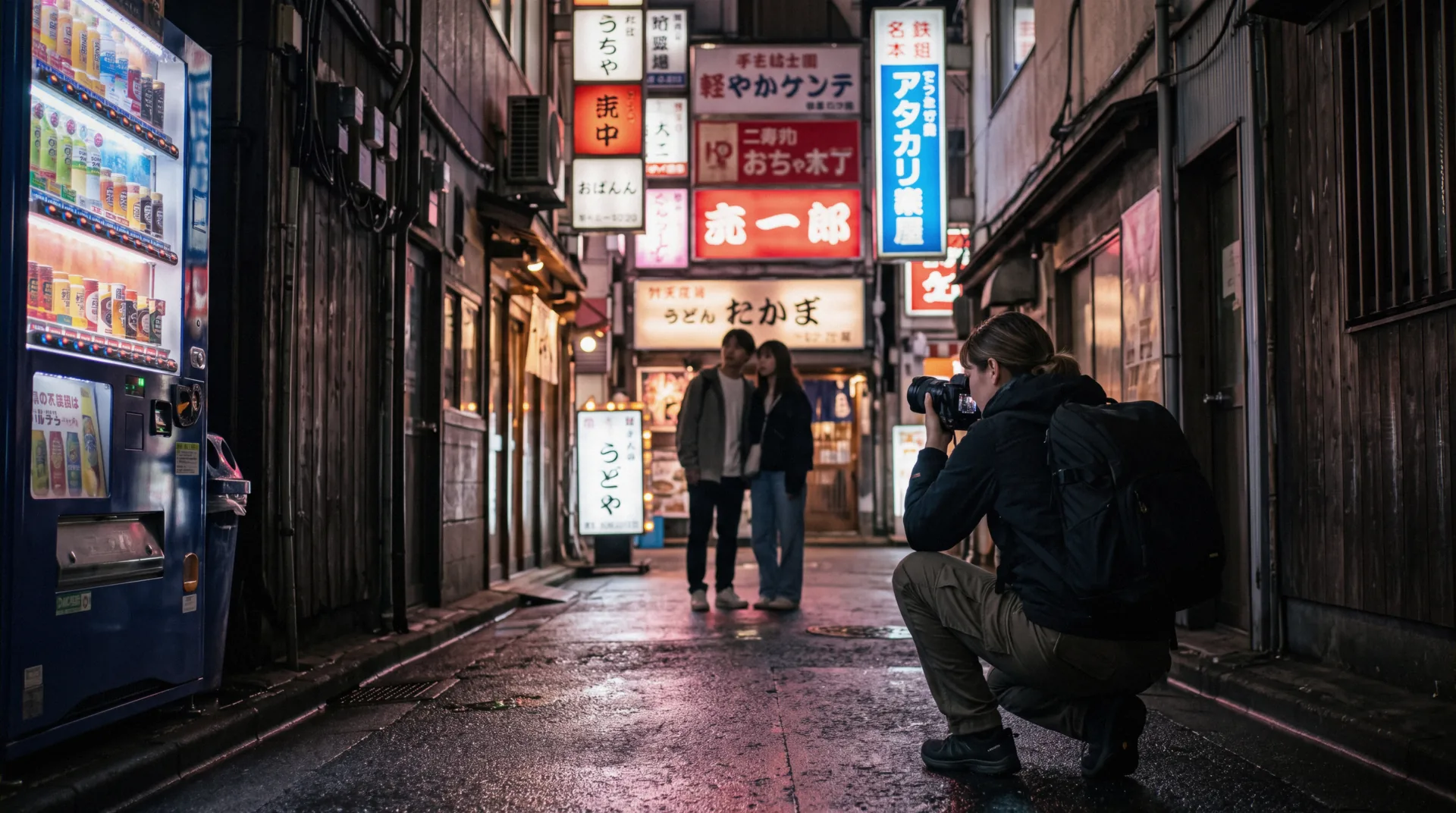
The working distance is closer than people imagine, and the direction is constant.
Quick answer The short version: five beats, and where the nerves actually go
A Tokyo session runs in five beats. The operator messages you first, usually on WhatsApp, and asks what mood you want. You meet at a named landmark, not your hotel. The first five minutes are a conversation and a couple of throwaway frames while you both calibrate. Then you walk, and the photographer directs continuously: where to stand, where to look, what to do with your hands. Afterwards the gallery arrives, anywhere from 48 hours to seven days later, or with no date at all on four of the listings. The session comparison shows which is which.
Key takeaways
- Five listings contact you before the session and two treat fifteen unannounced minutes of lateness as a no-show
- You are directed the whole way: multiple reviewers describe first-timers relaxed within minutes
- Nobody asks you to model. The most common instruction on these listings is to walk and talk while the photographer works
- The session ends on the clock, not when you feel finished: late arrivals shorten the shoot on most listings
- What arrives afterwards varies more than the session itself: 20 to 150 photographs, 48 hours to seven days
The Session, Beat by Beat
Times are for a standard one-hour street session. The studio sessions run differently and are covered further down.
-
A day or two before
The message
Most operators reach you on WhatsApp to confirm the meeting point and ask what you want: cinematic, moody, casual, couple, solo. One photographer confirms the exact time the day before. Answer it properly, because this is the only planning conversation you get.
-
10 minutes before
Finding the landmark
Meeting points are specific and public: a Starbucks by the crossing, Don Quijote in Kabukicho, the Hachiko statue, Yodobashi's west store. Arrive five to ten minutes early. Every listing says the session ends at its scheduled time whatever time you show up.
-
0 to 5 minutes
The calibration
A short conversation about the mood, then the first frames, which are mostly for you rather than for the gallery. This is where the awkwardness lives and where it ends. Reviewers who describe themselves as nervous or camera-shy consistently say it lifted here.
-
5 to 50 minutes
The walk
You move between three or four spots, being directed the whole way. One listing describes it as not a stiff pose-and-smile session and means it: you walk, talk and look at things while the photographer works around you.
-
The last 10 minutes
The specific requests
By now the photographer knows what works on you and you know what you want. This is the moment to ask for the frame you had in mind, which is exactly what one reviewer did when her photographer went out of her way at the end to shoot a spot she had picked.
-
Afterwards
The wait
48 hours on the fastest listings, two days on one, seven on another, and no published date at all on four. One gallery is deleted after thirty days. Ask before you book if the photographs are a gift with a date on them.
What Kind of Session Did You Book?
If a street session in Shibuya or Shinjuku
expect a walking hour with continuous direction, three or four stops, and the gallery as the only thing that arrives afterwards
If the Asakusa kimono walk
expect your booking time to be the studio check-in, with about two hours of dressing and hair before the first photograph
If the studio makeover
expect hair, makeup and dressing to take most of the two and a half hours, with the shoot itself at the end and every file handed over
If the portrait workshop
expect to be the photographer: theory, a hired model, off-camera flash and feedback, with your own camera in your hands
The Awkwardness Question, Answered by People Who Had It
Every listing claims no experience is needed. What makes that credible is that the reviews say the same thing in their own words, repeatedly, across different operators and different months.
What first-timers actually report
A traveller from the United States wrote that she was really nervous because it was her first time doing something like this, and that the photographer made it feel natural, like hanging out with an old friend. A German visitor to the Shinjuku session wrote that it was her first photoshoot and that the photographer gave her such a confidence boost that she felt the streets of Japan belonged to her. A guest from Austria said that even without much experience on his part, the photographer told him immediately when he needed to reposition. A Spanish reviewer noted that being photographed surrounded by other people was much easier than it could have been, which is the specific fear about Shibuya.
The pattern in those accounts is not that the subjects turned out to be naturals. It is that the direction is continuous and specific. Nobody is left to invent a pose.
The photographers' own method, in their words
The listings describe the same approach from the other side. One says gentle guidance is always provided so even beginners feel relaxed and confident. Another promises to guide you the whole way, where to stand, where to look, what to do with your hands, so first-timers relax within five minutes. A third talks about natural direction rather than posing. The cinematic session frames it as creative direction and adds one thing the others do not: a reviewer records that anything the couple did not want to do was dropped without argument.
If you would rather learn the skill than be its subject, the portrait workshop inverts the whole arrangement and hires a model for you to photograph instead.
| The worry | What the listings and reviews actually show |
|---|---|
| I will not know how to pose | Direction is continuous on every listing; several state it in the description |
| I will look stiff | Sessions are structured as walks, not studio setups, so movement does the work |
| People will stare | Shibuya and Asakusa are full of cameras; a session disappears into that |
| An hour is too long to perform | It is four stops with walking between them, and the first five minutes are the only hard part |
| I will not like the photos | Say the style you want in the pre-session message; the one weak review here came from a request made too late |
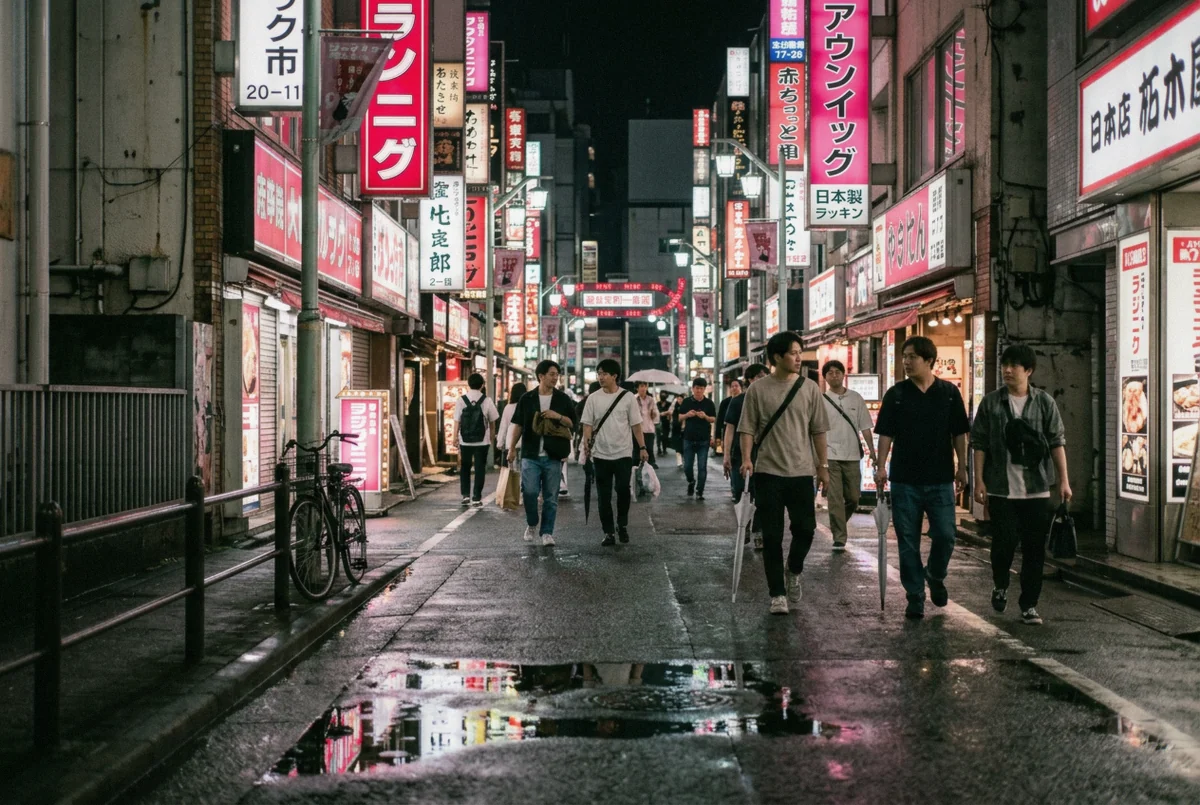
Most sessions in this catalogue happen here, after dark, on public streets.
The Practical Things Nobody Mentions Until You Are There
You will be photographed in public, and nobody will care
The single most common worry, and the least founded. Shibuya Crossing, Kabukicho and Nakamise are full of people photographing each other constantly; a session is invisible inside that. What does matter is the two Shinjuku alleys where photography is restricted by the landlord rather than by etiquette: Omoide Yokocho requires prior permission and Golden Gai requires the business promotion association's approval.
Both appear on session itineraries, so ask the operator how they handle it. The photo spots map lists which locations carry rules.
The clock is the operator's, not yours
Session time is fixed on nearly every listing. Two state that arriving more than fifteen minutes late without a message is treated as a no-show, one says a delay of more than half the session length may be. The studio sessions shorten rather than extend, because the next booking is already in the diary.
None of this is unusual, and all of it means the same thing: turn up early and the session is longer in the only way that counts.
Studio sessions run on a different clock entirely
If you booked a kimono makeover, expect two and a half hours in which the photography is the last part. Hair and makeup come first, then dressing, then the shoot in a private room, then the files. On the Asakusa rental the difference is sharper still: your booking time is the studio check-in, with roughly two hours of dressing and hair before any photograph is taken, so a two o'clock booking shoots around four.
What you can ask for during the session
More than people do. Say at the start if you want distant, environmental frames rather than close portraits: the one three-star review in this catalogue is from a traveller who wanted wide shots, mentioned it, and still received mostly half-body frames. Say if there is a spot you care about.
Say if you would rather not do something. All three are ordinary requests, and reviewers who made them got what they asked for.
What Arrives, and When
The session is an hour. The product is a set of files, and this is where the listings differ most.
| Session | Photos | Delivery |
|---|---|---|
| Cyberpunk neon | All usable frames, 35+ for one guest | 48 hours, guaranteed |
| Shibuya Crossing | Not published | 48 hours |
| Asakusa temple and river | 20, 50 or 75 by package | 48 hours |
| Instax night shoot | 20 edited plus 5 prints | 2 days |
| Cinematic street shoot | 80 to 150 graded, 15 to 20 retouched | 7 days |
| Kabukicho neon hour | 35+ edited | Not stated, and deleted after 30 days |
| Shibuya neon tour | 35+ retouched | Not stated |
Retouched, edited, colour-corrected: three different words
Read them carefully, because they are used loosely. Colour correction means the frame has been graded and nothing else. Editing usually means the same.
Retouching means work on skin and detail, and only a couple of listings quantify it: fifteen fully retouched frames on the 60-minute cinematic session and twenty on the 90-minute one. One listing promises professional retouching at no extra cost in its description and says basic colour correction only in its conditions. When in doubt, assume the cheaper meaning, and read the cost breakdown for what each tier really buys.
Download the gallery the day it lands
One Shinjuku listing stores photographs in the cloud for thirty days and then removes them. Nothing else in the catalogue publishes an expiry, but private galleries on link-based delivery are not permanent archives anywhere. Save the files, then enjoy them.
What to Expect: Questions People Ask
What happens in the first five minutes of a photoshoot?
A short conversation about the look you want, then a few frames that are mostly there to settle you. Every listing here describes the same approach, and reviewers who called themselves nervous or camera-shy consistently say the feeling passed within the first few minutes because the direction never stops.
Do you need to know how to pose?
No. The photographers direct continuously, and several listings say so explicitly: where to stand, where to look, what to do with your hands. One describes it as not a stiff pose-and-smile session, which is why the sessions are structured as walks rather than as studio setups.
What if you are late?
The session still ends on time. Two listings treat fifteen minutes of unannounced lateness as a no-show, one says arriving more than halfway through the booked time may be treated the same way, and the studio sessions shorten because the next slot is booked. Message the operator on WhatsApp if you are running late; every listing that mentions the app expects that.
How many photos do you actually get?
Between twenty and a hundred and fifty, depending entirely on the listing rather than on how the session went. The delivery table sets them side by side, along with how long each takes and the one gallery that expires after thirty days.
Can you ask for specific shots?
Yes, and you should say so at the beginning rather than at the end. The only sub-five-star review in this catalogue comes from a traveller who wanted distant, environmental frames, raised it, and still got mostly half-body shots. Stating the style in the pre-session message is the fix, and it is exactly what that message is for.
Is it awkward being photographed in a busy street?
Less than people expect. Shibuya and Asakusa are full of people photographing each other, and a session disappears into that. The real constraint is not the crowd but the two Shinjuku alleys that restrict photography by ownership, which is covered on the photo spots map.
What should you bring?
A charged phone with WhatsApp installed, comfortable shoes, an umbrella outside winter, and cash for the train, since transport is excluded on every listing that publishes exclusions. Outfit advice by district is in what to wear, and the Tokyo photoshoot catalogue has each session's own bring list.